NRNP 6541 week 10 assignment Articulate Assignment: Evolving Case Study: Preschool and School-Aged Children
The mother presents to your pediatric office with concerns that her 7-year-old son is not reading well and is failing English. The parent feels he gets distracted and loses focus. She states that he has poor attention to details.
 Administer a NICHQ Vanderbilt test
Correct! The NICHQ Vanderbilt test is administered to evaluate for signs of attention deficit disorder.
Administer a NICHQ Vanderbilt test
Correct! The NICHQ Vanderbilt test is administered to evaluate for signs of attention deficit disorder.
 10 mg Methylphenidate ER (30/70) PO daily QAM
Correct: This is generic for Metadate CD and is the best choice.
10 mg Methylphenidate ER (30/70) PO daily QAM
Correct: This is generic for Metadate CD and is the best choice.
 Increase the current medication from 10 mg to 20 mg.
Correct! Doses should be increased incrementally. Start low and go slow.
Increase the current medication from 10 mg to 20 mg.
Correct! Doses should be increased incrementally. Start low and go slow.

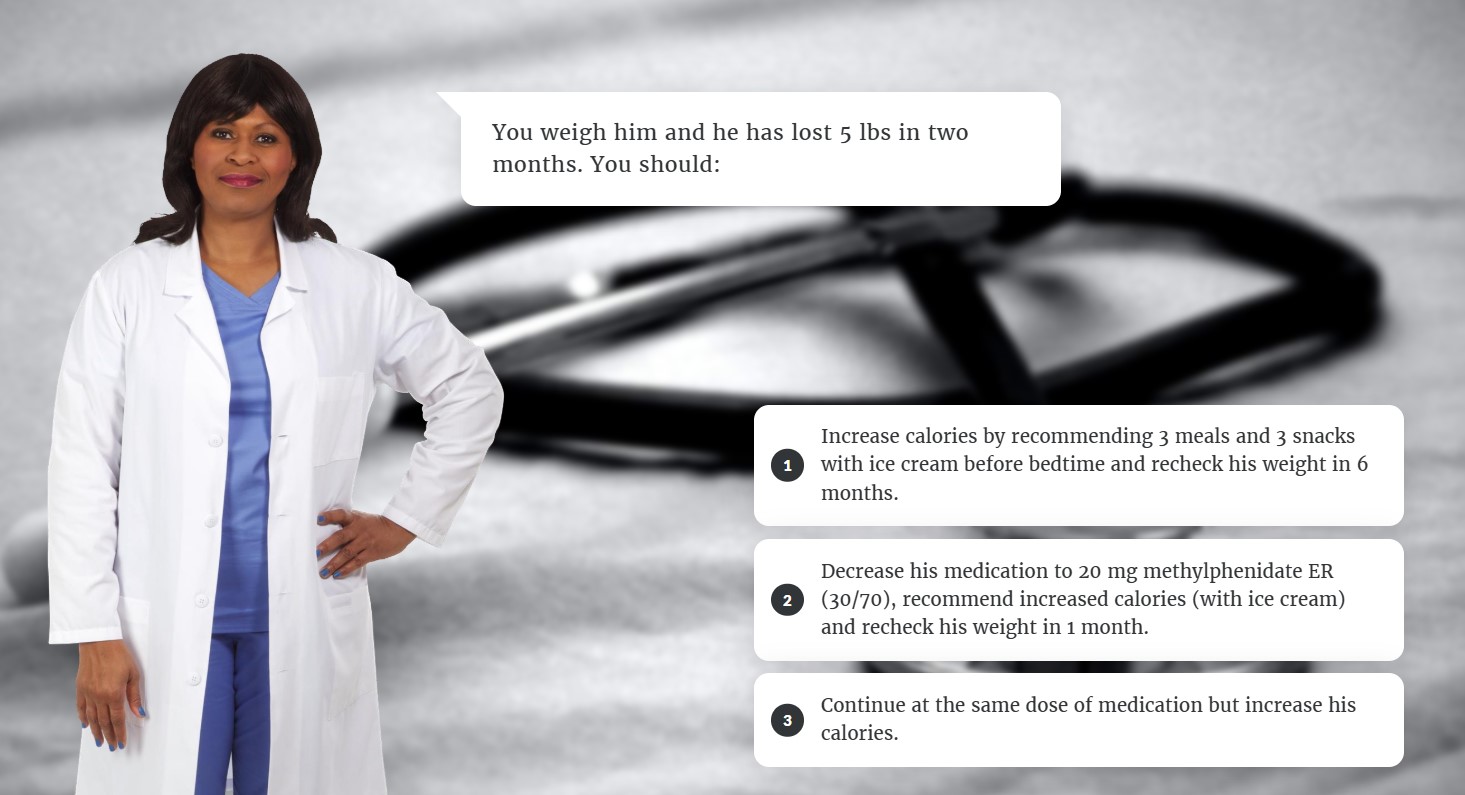 Decrease his medication to 20 mg methylphenidate ER (30/70), recommend increased calories (with ice cream) and recheck his weight in 1 month.
Correct! It is important to decrease the medication when you hit significant side effects such as weight loss or issues sleeping. You still should recommend increased calories.
Decrease his medication to 20 mg methylphenidate ER (30/70), recommend increased calories (with ice cream) and recheck his weight in 1 month.
Correct! It is important to decrease the medication when you hit significant side effects such as weight loss or issues sleeping. You still should recommend increased calories.
Administer a NICHQ Vanderbilt test
Correct! The NICHQ Vanderbilt test is administered to evaluate for signs of attention deficit disorder.
10 mg Methylphenidate ER (30/70) PO daily QAM
Correct: This is generic for Metadate CD and is the best choice.
The mother adds that her son has a history of club foot, which is repaired
However, he walks with a limp, and kids tease and bully him. They imitate the way he walks, and he now states that he does not like school and does not want to go.
 That the patient should set up mental health counseling for her son and that you will give a referral for such.
Correct. Good choice! The patient should be referred to counseling.
That the patient should set up mental health counseling for her son and that you will give a referral for such.
Correct. Good choice! The patient should be referred to counseling.
That the patient should set up mental health counseling for her son and that you will give a referral for such.
Correct. Good choice! The patient should be referred to counseling.
FOLLOW-UP: 3.5 Weeks
You see the family back for a follow-up visit 3.5 weeks later after starting 10 mg of methylphenidate ER (30/70). The patient has gained 1 lb and is able to sleep well.
Increase the current medication from 10 mg to 20 mg.
Correct! Doses should be increased incrementally. Start low and go slow.
Decrease his medication to 20 mg methylphenidate ER (30/70), recommend increased calories (with ice cream) and recheck his weight in 1 month.
Correct! It is important to decrease the medication when you hit significant side effects such as weight loss or issues sleeping. You still should recommend increased calories.
SUMMARY (1 of 5)
After adjusting the medication to 20mg methylphenidate ER (30/70), the patient returns a month later and has gained 6 lbs. He is no longer having any issues sleeping. His grades remain excellent.
SUMMARY (2 of 5)
He has not had additional issues with poor attention at school. He is now seeing a mental health therapist and receiving cognitive behavioral therapy, which has helped with school avoidance issues.
SUMMARY (3 of 5)
He has not had additional issues with poor attention at school. He is now seeing a mental health therapist and receiving cognitive behavioral therapy, which has helped with school avoidance issues.
SUMMARY (4 of 5)
The therapist recommended interventions at school which has eliminated the bullying. The patient states, “I did a class presentation on club foot and showed pictures of my funny baby feet . . .
SUMMARY (5 of 5)
. . . and the x-rays from my surgeries. My classmates asked to see my scars and it was cool to show them. Now kids play with me instead of tease me. I like school again.” NRNP 6541 week 10 assignment Articulate Assignment: Evolving Case Study: Preschool and School-Aged Children